



SPRING 2020 Update
PA River of the Year Results
We (a bit begrudgingly) congratulate the Lackawanna River Conservation Association for winning the 2020 PA River of the Year for the Lackawanna River. Thank you to all those who voted for the Brandywine, we came in third place with more than 3,000 votes! And thank you to the Pennsylvania Organization of Watersheds and Rivers (POWR) for holding this annual contest which "...is done to raise awareness of the important recreational, ecological, and historical resources associated with the state’s rivers and streams."
POWR shared that most of the winning rivers don’t win on their first attempt, so, maybe next year?!
Valley Forge Trout Unlimited 40th Annual Trout Show
Saturday, March 28, Lionville Middle School, 1 pm to 4 pm. Valley Forge Trout Unlimited holds their 40th Annual Trout Show. It is open to the public with a donation of $5.00, children under 12 free. All proceeds will be used for environmental restoration and protection of northern Chester County trout streams.
The show features:
- Tom Gilmore, presenting a great program on fishing Pennsylvania's internationally renowned trout streams
- Displays by conservation and environmental groups
- Project Healing Waters tying flies
- Raffles for fishers and non-fishers alike. Raffles prizes include top end fishing and camping equipment, trail bike, kayak, artwork and much more
- Special kids-only raffle with appropriate prizes
Tom Gilmore served for three decades as the President and CEO of New Jersey Audubon, the tri-state’s oldest and largest conservation organization. Tom has been an ardent fly fisherman for 45 years, and has landed over 12,000 game fish on a fly — everything from trout to tuna and bonefish to billfish. He has been an outdoor writer for the last 15 years, having published five books and numerous articles. His newest book “Flyfisher’s Guide to Pennsylvania” was published by Wilderness Adventures press September 2016. Tom currently writes feature stories for Eastern Fly Fishing and American Angler.
Pipeline Workshop
Saturday, March 21, West Whiteland Twp Building, Main Meeting Room, 8:30 am to 3 pm.
Pipeline Safety Coalition sponsors a workshop which will provide information and an opportunity for local dialogue on pipeline safety and community resilience as identified by participants in the Pipeline Safety Coalition’s Chester County Community Awareness Network (CAN)*, the Chester County Department of Emergency Services, local officials, and pipeline operators.
Participants in the workshop will:
- Meet members of Chesco CAN and learn about the CAN promotion of proactive, resilience-based public engagement.
- Receive a CAN Pipeline Safety Guidebook on Emergency Preparedness, Response, and Technical Pipeline FAQs. (Pre-register to reserve your Guidebook)
- Learn about the National Pipeline Survivor Support System (NPS3) as a trauma-informed and resilience-based initiative that empowers local residents to protect themselves from pipeline infrastructure risks.
- Participate in a dialogue with other Chesco residents, experts in trauma-informed practice, emergency preparedness and response, and disaster assistance.
- Provide feedback and input on developing CAN and NPS3 as initiatives to advance national and regional legislation towards greater public engagement in all aspects of oil and gas pipeline infrastructure from planning and construction to abandonment and decommissioning.
The workshop will be professionally facilitated by an expert in pipeline conflict mitigation and engagement. Speakers from state and national public health and disaster assistance organizations will present their work in assisting and engaging communities before, during, and after a crisis.
Lunch will be provided for pre-registered participants.
Doors open at 8:30 AM, workshop starts promptly at 9:00 AM
Contact Lynda Farrell at lynda@pscoalition.org to register.
Girls Canoe Camp 2020
Girls Canoe Camp 2020 is accepting applications! There will be 3 camps available this year and for first time participants, there is no cost. Connie Nye from SWEET will be conducting the camps and sharing her enthusiasm for all things water!
This is a great opportunity for girls to disconnect from technology, learn canoe skills, improve self-reliance, build confidence and increase their watershed knowledge.
Camp dates and age requirements are:
- June 29-July 2 - new girls only, ages 10-13
- July 27-31 - girls, ages 10-13
- August 24-27 - high school girls
Applications are due May 1.
Brandywine Creek Water Trail Feasibility Study, Input Requested
The Brandywine Conservancy is pleased to announce that the Draft Brandywine Creek Water Trail Feasibility Study is now available for public review and comment. The study reflects more than a year’s work and includes guidance provided by the Study Advisory Committee and input from hundreds of individuals who either participated at public meetings or completed our online public survey. To download the study or read online, click here. To download the appendices or read online, click here.
Read the report and offer your input by March 31. Send comments on the Feasibility Study to rdaniels@brandywine.org.
WINTER 2019 Update
Brandywine Nominated for PA River of the Year
The public is invited to again vote online for the 2020 Pennsylvania River of the Year, choosing from among five waterways nominated throughout the state. Waterways nominated for 2020 are Brandywine Creek, Buffalo Creek, Connoquenessing Creek, Lackawanna River and Ohio River.
After a waterway is chosen for the annual honor, local groups implement a year-round slate of activities and events to celebrate the river, including a paddling trip, or sojourn. The organization nominating the winning river will receive a $10,000 leadership grant from DCNR to help fund River of the Year activities.
POWR and DCNR also work with local organizations to create a free, commemorative poster celebrating the River of the Year.
Voting is open until Friday, January 17, 2020, 5pm.
VOTE for the Brandywine
FALL 2019 Update
Girls Canoe Camp Sojourn 2019
Canoe Camp provided another opportunity to teach young minds about our watershed through a sojourn experience. Each day started at Northbrook Canoe Company for team building games and watershed lessons. Girls supplemented their outdoor classroom instruction with paddling on the East and West Branch, Brandywine), a native plant guide hike at Brandywine Conservancy and creek snorkeling instruction by North Bay Adventures.
Their water cycle lessons were brought full circle with tours of the Downingtown drinking water plant (Downingtown Municipal Water Authority) and the Downingtown waste water treatment plant (Downingtown Regional Water Pollution Control Center) and a final day celebration which included Victory Root Beer made using water from the East Branch.
Thank you to Connie Nye and her SWEET staff for bringing and sharing the magic and enthusiasm that made this another memorable watershed experience. Canoe Camp Sojourn 2019 was increased to two weeks through grants from Victory Brewing Company and POWR (PA Organization for Watersheds and Rivers).
The Impact of Non-Point Sources of Contamination on the Biogeochemistry of a Rural to Urban Watershed
We have help to fund several studies focused on the health of our watershed. Initial analysis of the latest study on non-point source contamination conducted between streamwater conductivity (a proxy for road salt) and upstream land use practices for the study period suggests there is a strong statistical relationship between streamwater conductivity and the amount of upstream impervious surface cover. Development matters.
This study included:
- 12 monthly sampling events of 13 points within the watershed
- 4 quarterly sampling events of locations upstream and downstream of five low-volume (<500MGD) WWTPs, including those on Indian and Culbertson Run
- 26 bi-monthly samples of three locations (Dowlin Forge, Beaver, Creek, and below Downingtown)
We expect this study to conclude by spring of 2020 at which time we will share the final analysis on the health of our stream.
SPRING 2018 Update
Stone Bench for the UEB Community
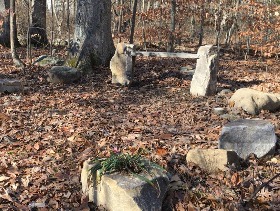 |
There’s a special spot in Burgess Park that now provides a beautiful view of the Upper East Branch from a stone bench custom designed by Devin Devine, a local PA stonemason. With donated funds, we completed this project in November 2017. With its natural appearance the stone bench blends into the woods and boulders that surround it and could be easy to miss. Find it in Burgess Park and you will have found a lovely, quiet location to sit, view and enjoy the the Brandywine! |
Girls Canoe Camp for Summer 2018
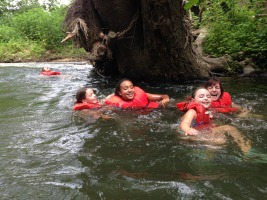
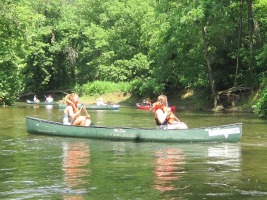
Update: Due to the positive response to our Girls Canoe Camp, we have increased the number of slots to 20!
All applications have been reviewed and we have sent acknowledgements to the lucky 20 girls who will canoe down the Brandywine Creek and learn about the watershed. The girls will spend 4 days learning canoe skills, paddling, learning about the watershed, conducting scientific tests and having fun!
Know any girls who might be interested in spending four days canoeing down the Brandywine and learning about our watershed? If you do, then please read on:
Join the outdoor adventure day camp of 2018! Canoe way down the Brandywine Creek and learn canoe skills, make friends, swim & play in the creek, run scientific tests, and learn about water, water critters, watersheds, and water stewardship. Includes 4 days of canoeing with other learning activities!
-
Free to participants due to the generosity of Guardians of the Brandywine
-
For GIRLS ages 10-13 (or entering grades 5-8)
-
August 13-20 9 AM to 4 PM
-
Start & end daily at: Northbrook Canoe Company, 1810 Beagle Road, West Chester, PA
-
Applications for 12 positions due June 30, 2018
-
Camp is led by Connie Nye: environmental educator, canoe instructor, author, fun-maker
FALL 2015 Update
Victory for the Headwaters River Clean-Up and Fundraiser
Saturday - September 12, 2015
11:30 am to 4 pm
Cancelled due to low water levels. Clean-up will take place in the spring.
Victory for the Headwaters Fundraiser Party
Saturday - September 12, 2015
4 pm to 8 pm
Cancelled.
Run for the Headwaters
Sunday - September 20, 2015
9:30 am to 4 pm
 Victory will be hosting the first annual Run for the Headwaters 5K to raise money for the Headwaters Grant which supports local watershed protection groups. Come enjoy a run through the heart of Downingtown on a beautiful fall day and celebrate at the finish line with a cold Victory beer – Drink Headwaters, Save the Planet!
Where: Downingtown Brewpub
420 Acorn Lane
Downingtown, PA 19335
Cost: $35-$40
Preregistration is open until 8:00PM on September 17. If you would like to register on race day, registration will begin at 9:30AM. The race will begin at 11:00AM. The Victory Brewpub on Wheels will be located in the Victory parking lot serving food and beer after the race.
The course is USATF certified.
To register for the race, click here.
Victory for the Headwaters events are rain or shine.
If you can't attend these events, you can still make a donation to Victory Headwaters Grant HERE
Drink Headwaters, Save the Planet!
Saturday - October 31, 2015
Tentative Date for Understory Tree Planting
Route 282/Dowlin Forge Tree Planting Site in East Brandywine Township
Join Brandywine Conservancy and Guardians to plant understory shrubs and plants to enhance this site.
Details forthcoming!
SUMMER 2015 Update
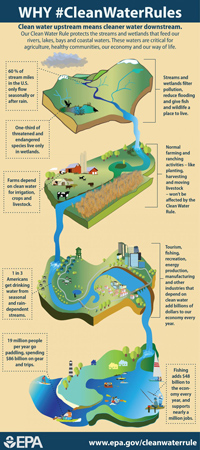 |
Clean Water Rule Finalized!
|
SPRING 2015 Update
Volunteers Needed: Wyebrook Farm Tree Planting
on Saturday, April 18, 2015 from 9am to 2pm
Join the Guardians of the Brandywine, Brandywine Conservancy, Victory Brewing Company and Wyebrook Farm as we plant a riparian buffer to ensure the quality of the Upper East Branch, Brandywine Creek.
- Who: Anyone who enjoys trees, dirt or doing a good deed
- When: Saturday, April 18, 2015, 9 am to 2 pm
- Where: Wyebrook Farm
150 Wyebrook Rd.
Honey Brook, PA 19344
- Wear: Heavy shoes or boots, clothes that don't mind a little dirt.
- Bring: Shovel, hammer, gloves, water bottle
- Directions: click for directions.
Arrive when you can, leave when you must! It helps to know who will attend, so if you can email the Guardians at: guardiansofthebrandywine@gmail.com or call (610) 883-7142.
FALL 2014 Update
Downingtown FallFest - Sunday, September 28th, 12 to 4pm
 Come on out and find out why this event grows bigger and better each year.
Enjoy food, live music, crafts, performances, meet local businesses and organizations
and relax in the Victory Beer Garden. We don’t have a booth number yet but we will be there!
Come on out and find out why this event grows bigger and better each year.
Enjoy food, live music, crafts, performances, meet local businesses and organizations
and relax in the Victory Beer Garden. We don’t have a booth number yet but we will be there!
For more details visit the Fall Fest web site.
Wyebrook Farm Tree Planting - Saturday, October 18th, 9 to 5pm
The bucolic scenery of Wyebrook Farm will be the backdrop for this planting along the “Headwaters” of the Brandywine in Honey Brook Township. Join us, Brandywine Conservancy, Victory Brewing Company and Wyebrook Farm as we plant a riparian buffer to ensure the quality of the Upper East Branch (and perhaps some of our favorite beers!) Who: Anyone who enjoys trees, dirt or doing a good deed.
When: Saturday, October 18, 9 am to 5 pm
Where: Wyebrook Farm
150 Wyebrook Rd
Honey Brook, PA 19344
Wear: Heavy shoes or boots, clothes that don't mind a little dirt.
Bring: Shovel, hammer, gloves
Directions: http://wyebrookfarm.com/map-directions/
It helps to know who will attend, so if you can email me. If you haven’t visited Wyebrook Farm, don’t wait til October! Head over when you’re hungry and satisfy your appetite with their delicious and sustainable farm to table menu. Free Live music on Saturday afternoons! (I think reservations are suggested for weekend dinner.)
Take Action – Support New Riparian Buffer Legislation
Pennsylvania State Senator John Rafferty (44th Legislative District) has introduced legislation that seeks to improve the Commonwealth’s water quality by:
- establishing riparian buffer protections for new development projects
- encouraging local governments to craft and enforce effective buffer ordinances
- supporting statewide action in the absence of municipal ordinances.
The proposed Riparian Buffer Protection Act, SB 1465, will only impact future development and would encourage a minimum 100-foot buffer for all streams, a minimum 300-foot buffer around Pennsylvania’s cleanest steams (those designated High Quality or Exceptional Value) as well as increased protections for streams listed as impaired by the state (streams that are failing to meet their water quality standards). The Upper East Branch is a High Quality stream. Read more about this at the Delaware Riverkeeper website and take action by signing a letter endorsing this legislation. .
SPRING 2014 Update
Tree Planting - Saturday, April 19 2014
Due to severe winter weather, the East Brandywine tree planting event has been changed from Saturday, April 5 to Saturday April 19th. Same time and location (see below)
Forests once covered 75 to 90 percent of the Brandywine watershed. Now only 28 percent of the watershed is forested. Help us restore the tree cover and tree vitalize our watershed!
Join us and our partner in planting, the Brandywine Conservancy, as we complete the last planting phase for the Rt. 282/Dowlin Forge site in East Brandywine Township. With only 600 trees to plant, this planting will take just a few hours to complete!
When: Saturday, April 19, 2014, 9 am to 1 pm
Where: Rt. 282 (Creek Rd.) & Dowlin Forge Rd.
Wear: Heavy shoes or boots, gloves, clothes that don't mind a little dirt.
Bring: if you can - Shovel, hammer
It helps us to know who will attend, so if you can either call me at 610.883.7142 or email guardiansofthebrandywine@gmail.com.
Check out our "Winter in Our Watershed" photos on our Photo Gallery page.
Congratulations to Victory Brewing Company who recently received the prestigious 2014 Sustainable Agriculture Business Leadership Award!
Click here to read: Archived Updates from 2013, 2012, 2011 and 2010
Our Mission
As our mission is to preserve the rural character of Wallace Township, our activities focus on the protection and enhancement of the waters and other natural resources of the Upper East Branch of the Brandywine Creek's Watershed, including all of its tributaries.
We believe that the mission requires us to educate the public about the quality of our natural resources and the quality of life enjoyed by our predecessors, and to further inform the public of the challenges to these qualities posed by the pressures of the twenty first century.
Preservation and maintenance of riparian buffers are at the top of the list of the subjects which the public must understand if the Brandywine waters and surrounding environs are to be preserved from deterioration. This entails hiring counsel and scientists to gather and analyze data, review planning and land use, and the study the environment. Their findings are then conveyed to the community through Guardians’ educational outreach.
Guardians of the Brandywine, Inc. (“Guardians”) is a non-profit corporation and has been approved by the Internal Revenue Service as a 501(c)(3) tax-exempt Public Charity. Contributions to Guardians are tax deductible to U.S. taxpayers to the extent permitted by law. Non-reimbursed expenses related to volunteer work with Guardians are tax deductible for volunteers who file itemized tax returns. Speak with your tax preparer regarding taking tax deductions for your contributions or volunteer expenses.
Funds raised by the Guardians of the Brandywine, Inc. will be used to educate the public and protect the Brandywine within the restrictions of the IRS 501 (c) (3), relating to charitable contributions. We believe that the natural resources associated with the Brandywine Watershed are themselves incapable of political affiliation,we intend to see that our organization should also be without political affiliation. We expect to educate all who will hear our message about preservation and conservation of the Brandywine Watershed, regardless of anyone’s political affiliations. As an organization, we have no political affiliation or involvement.